
Why I taught a machine how to not write a press release.
How I’m streamlining news management with help from Claude.
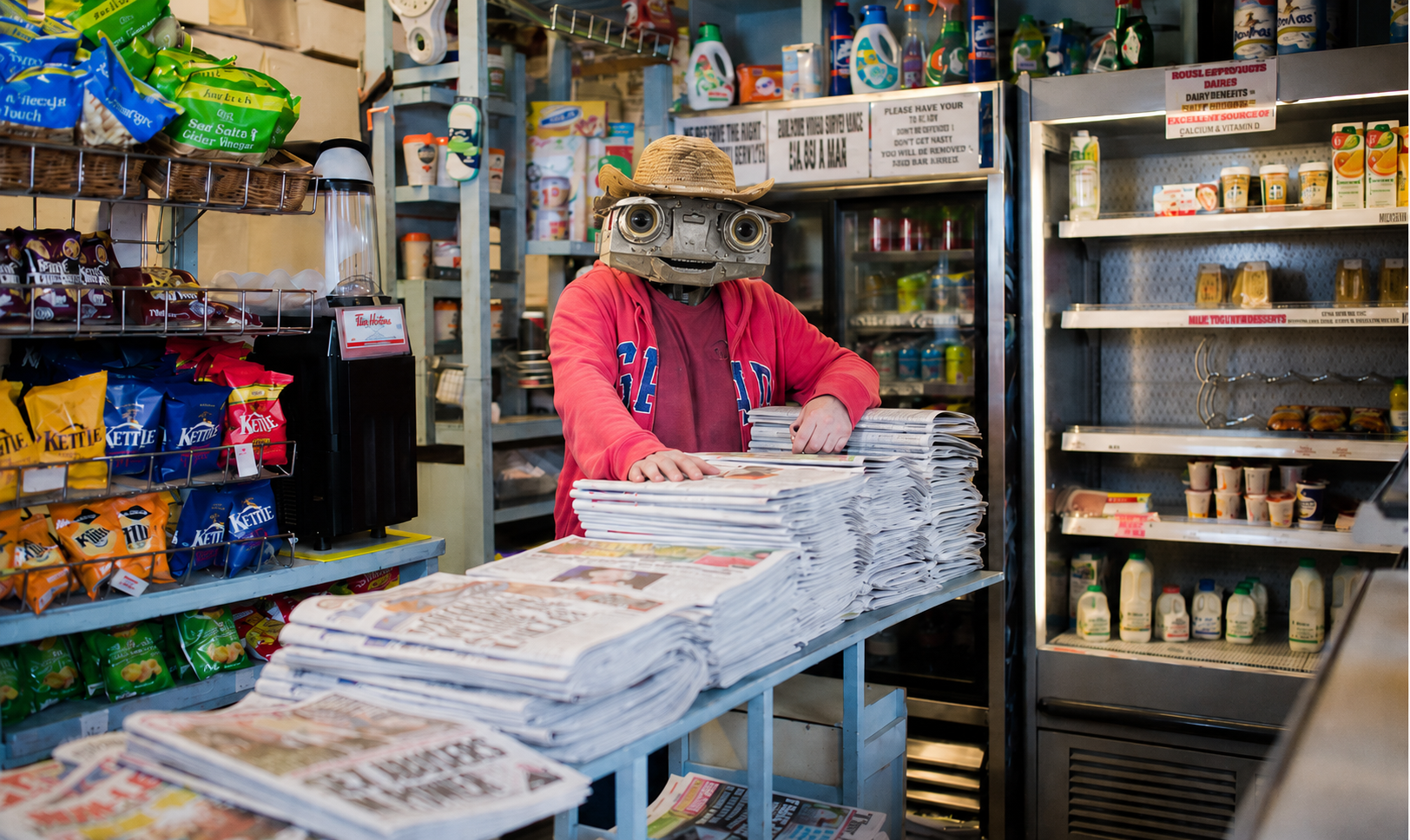
First I asked for a ‘Robot News Agent’. Wasn’t happy with the initial results.
Most press releases should never get written.
That isn't cynicism. After 25 years in PR, earning thousands of pieces of coverage (and seen more pitches than I’d like ignored) it's the most useful thing I know about news.
The hard part of PR isn't writing a press release, it's deciding whether there's a story there at all (and if there isn’t, the work you do to create it).
Get the story right and the press release will work. Get it wrong and you're pushing noise at journalists with whom trusted relationships really matter.
I’ve spent the last six months working much more closely with AI, thanks to a brief session with Eamon in December (where he taught me how to write a custom GPT in ChatGPT) and since February the gradual integration of Claude into more of my workflows.
I’m not a natural fan of AI for a number of reasons, but have come to believe that the future knowledge economy will be divided by those who use it to transform into SaaS-like businesses and those who ignore it and remain ‘hand-cranked’ from soup-to-nuts as the Americans say.
So I’ve belatedly been getting to grips with it.
When I set out to review how AI could support my news management process, the first thing I built wasn't a writing tool. It was a filter for helping clients to assess how newsworthy their content is, and help us collaborate to make the story as strong as it can possibly be.
Where news management fits in Full Funnel PR
I will do more work to explain what Full Funnel PR is, why it’s different, how clients can use it, what I plan to do with it and so forth in coming posts, and there is a high-level description on my website here.
But in a nutshell it’s a business system that allows growth businesses to use PR to drive specific objectives, and (over time) build in-house PR capability by closing the gap between where they are and how the elite PR operations work in large firms.
It has nine interlocking ‘pillars’ one of which is called “PR Assets” - which is where press release creation lives. It's where everything upstream (the commercial objective, the key messages, the spokesperson's voice, the topical hooks) gets converted into something a journalist can use.
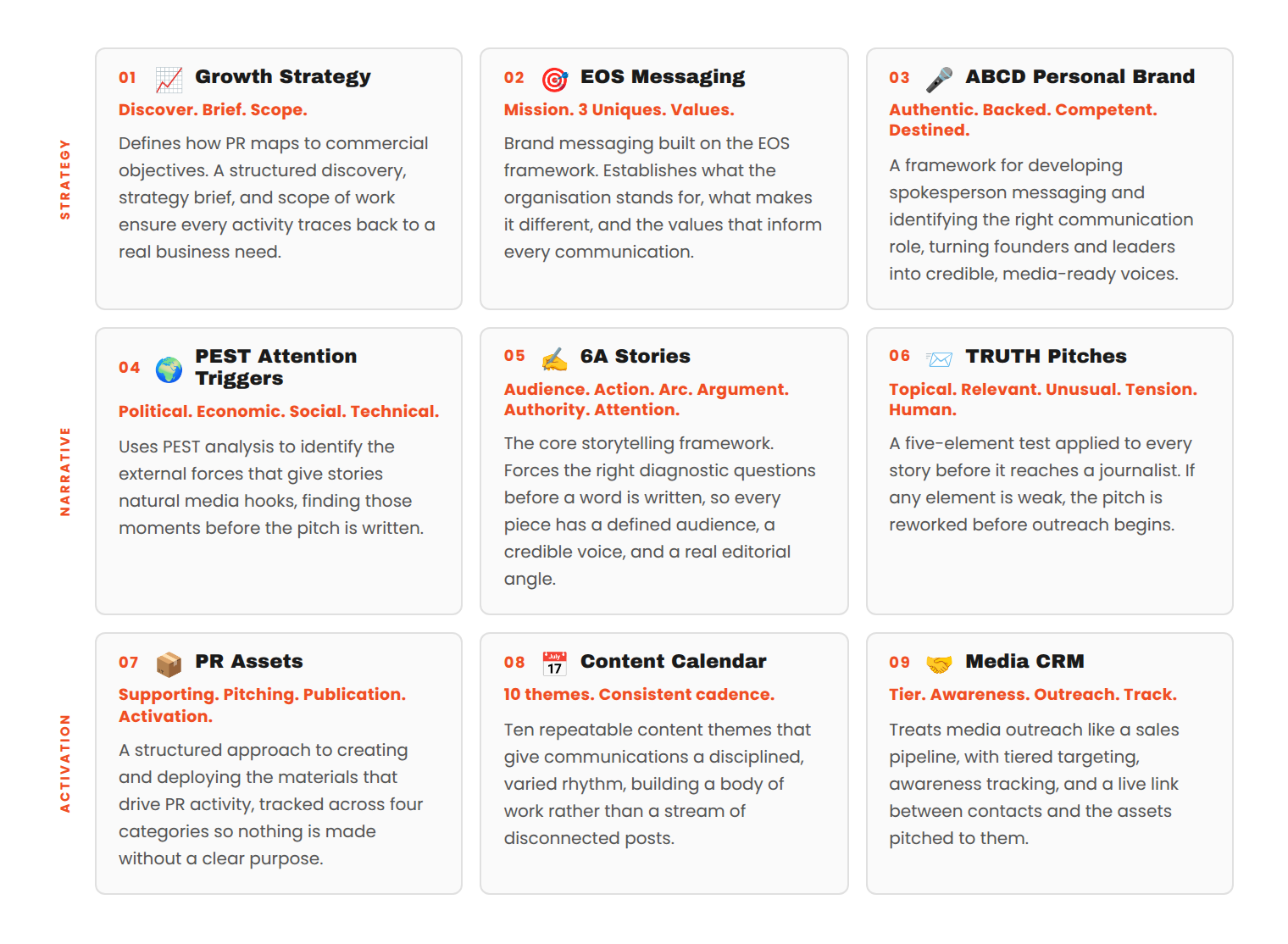
News management draws on all components of the system, but sits within pillar 7 >“PR Assets”
Strategy decides why we're doing this. Messaging decides what we stand for. News management is where the method meets the media.
The press release is the core asset there. It exists to put new, time-bound facts on the record: a thing was done, a number changed, a relationship formed. If none of that has happened, it isn't news, it's an opinion, and it needs a different vehicle.
First, I used Claude to define the method
For most of my career, this judgement lived in my head.
I could look at a client's "announcement" and judge whether it would earn coverage, get reduced to a news-in-brief, or die in a journalist's inbox.
But "trust me, I can feel it" doesn't wash with clients, and can't be automated.
So I used Claude as a thinking partner to force my tacit knowledge into the open and translate it into a product.
Step One was to train an old schema I developed a few years ago to assess the news at face value - my HOT / POT / BOT / NOT impact test.
🔥 HOT NEWS: the story has a famous name or a big, credible impact number. It'll work on its own.
🪴 POT NEWS: coverage could grow with nurturing ie adding a few elements to the story. It’s not ‘oven ready’ but it has potential.
🤖 BOT NEWS: a real event, but lacks names or numbers. Wire distribution - so it’s on the record and findable but unlikely to earn coverage.
🚫 NOTNEWS: No time-bound event, more opinion than fact. For this I’d say don't write a release. Write a comment or an op-ed instead.
Within each classification there is of course nuance: newsworthiness is subject to a range of factors such as what else is on the journalists’ minds, timing, the editorial policy and myriad other things. But a hard think about impact gives you a reliable baseline to work from.
This classification is important because each suggests a different playbook, in terms of how you get the news out and leverage it: while HOT NEWS may lend itself to a press conference or event platform and ‘the whole nine yards’ in terms of selling in to the media (a three-month project), BOT NEWS may be a 30 min job to post on a wire and leave it at that.
Knowing this from the get go gives you a clear sense of how to plan (not to mention how it can help manage expectations on the client side).
Step Two is a deeper, 13-question briefing. Clients (quite understandably, and especially non-PR people) can often confuse events that matter to them with events that interest journalists.
The briefing starts to pin down the facts, the impact number, the before-and-after arc, the names involved, the proof points, and who can be quoted. Get as much information as you can before anyone starts drafting.
What makes AI incredible is that you can tell Claude information once, and it will not only remember it but identify inconsistencies. If you’ve done PR before you’ll know how challenging story creation can be when information is not kept in the same place, and narratives live mostly in people’s heads.
It's a huge time-saver, too. Because the news now sits inside a system, the AI knows where to look for what you've already told it - which speeds up fact-checking and approvals, and means clients aren't answering the same question twice.
Step 3 was a list of non-negotiable drafting rules.
For example - list big names and numbers in paragraph one, never paragraph three. The only place you're allowed to editorialise or use flair is in the quote (the rest is concision and fact). Spokespeople banned from being "delighted", "excited", or "proud to announce" - just put the key message in or (better) if it’s a partnership, carry the partner’s key message in your quote - and more.
The unexpected benefit: making the method legible to an AI made it sharper for humans too. Every ambiguity I'd been carrying as "judgement" had to become an explicit rule or an explicit question. Each method page now even ends with a section of plain instructions written for Claude to follow, which doubles neatly as an explainer for those who need it.
Defining came first. It had to. You can't automate a process you can't yet articulate.
Second, I used Claude to automate
Once the method was explicit, automating the front end was the next move.
The judgement and the briefing (the hard bit) is now a set of rules and questions. That's exactly the kind of thing you can put behind a form.
So I built one. Claude does two jobs inside it: it runs the impact assessment, and it produces a first draft against the method's structure.
The model handles the legwork; the method governs what 'good' looks like. The result is a first draft far better than anything I'd start from a blank page, and a client who can assemble the information I need before I'm even involved. Much more time-efficient.
So AI brings together model and method: a model with no method just generates more of the slop journalists are already drowning in. A method with no model is slower than it needs to be.
This gives me more time and space to do the creative and relationship work that needs a human: the hard probing with the client to shape the story into the best it can be, the relationships, the pitching, the exclusive, the editorial judgement on a borderline call.
Third - The Full Funnel Newsagent!
OK… I probably won’t call it this for fear of invoking old-school images of WHSmith but you get the gist.
I won’t go into the tedium of how I did the plumbing to connect the app to my website, but the upshot is my first client-facing web app that ingests client information and applies my method before I ever touch the work.
Here's what happens when a client uses it:
They fill in a short brief: the facts, the impact, the context, the angle, the names, the spokespeople, the photography.
The agent assesses the news against HOT / POT / BOT / NOT and hands back a verdict, the strengths, and (crucially) the gaps. If it's a NOT, it says so, and suggests a different workflow other than a press release.
The client closes the gaps in a few targeted follow-up questions.
The agent drafts a release to the method's structure i.e. names and numbers up top, a human-sounding quote, no salesspeak, placeholders flagged where a figure is still missing.
It lands in my inbox as a ready draft with a covering note, and the brief is saved automatically in Notion (which I use for storage) so nothing gets lost.
For a client, this turns "I think we should put out a press release" into a structured, honest assessment in minutes. For me, it means every brief that reaches my desk has already passed through the method, so my time goes on the judgement and the pitching rather than chasing missing facts.
It's live, embedded on my site behind a client login, and it's the first of several method components I'm turning from a documented process into working tools.
At time of writing I’m honestly undecided about where I take Full Funnel PR. But part of it will include building AI tools to automate my PR workflows, standardise the methods and allow me to work more productively with clients. That will allow me to focus my time on the relationships, thinking work and creative stuff I actually enjoy.
What next?
Anyone can now generate a press release in ten seconds. That's precisely why doing it well is worth more, not less.
The scarce thing was never the writing: it was the judgement about whether there's a story, and the discipline to say no when there isn't.
I used Claude to make that judgement explicit, and then to automate the parts that don't need me. What's left is the part that always did: telling a client the truth about their news, and getting it in front of the right journalist.
This agent is far from the finished article: it’s the first version of my first product. The start of the journey.
V1 can be found here: https://mattphillipspr.com/pressreleasedrafter
I’m keen to get feedback on it so if you have a piece of news (real or fake) you’d like to bench test it with, please do.
Or if you’d prefer a simple human-to-human chat about PR generally and how it could drive your business forward, get in touch (I still do those as well)!